King Alfred

Recent excavations have revealed the foundations of Hyde Abbey, Winchester, and information at my disposal regarding the burial of King Alfred seems relevant here. A summary is given below:

Alfred’s first recorded burial site in 901 was in the Old Minster from where he was reburied in the New Minster on its completion, eventually being translated to the great Hyde Abbey about a mile away. Only a few years after the Dissolution of Hyde in 1539, ‘Leyland’ the King’s antiquarian, records that ‘little tablets of lead’ bearing the names of Alfred and Edward were found in the tombs. The phraseology suggests that the tombs were opened, but there is no mention of the fate of the coffins or remains.

In 1788, further clearance of the site revealed the outline of the east end of the church where the site of the High Altar was established and where “a great stone coffin was found cased in lead both within and without and containing some bones and remains of garments. The lead in its decayed state was sold for two guineas – the bones thrown about and the stone coffin broken into pieces. There were two other coffins and no more found in this part …”

In 1866 John Mellor arrived in Winchester with the stated aim of finding royal remains which he claimed to have done with such speed that: “this self-styled antiquarian … breaking into some chalk graves … came across fragments of skeletons, one of which he immediately fixed upon as being that of King Alfred himself … by evidence of a leaded plate with the letter ‘A’ stamped on it”.

The plate was found to be of modern manufacture, which together with other inconsistencies about the excavations left Mellor’s findings worthless, and the remains he unearthed being reburied in St Bartholomew’s Churchyard.

Recent excavations found three tomb sites in the centre of the Apse where the High Altar stood – see plan here and the aerial photograph below.

Aerial Photo

Posted in Wessex | Tagged , , , , | Leave a comment

Westminster Abbey – King Edward the Confessor – 1042-1066

In 1993, perhaps one of the most amazing documents to come into my possession was a series of extracts from the records of The Abbey. One concerned the remains of Edward The Confessor and recalls how in 1102 (the King died in 1066) the tomb was opened by Abbott Gilbert in the presence of Henry i and a Norman chronicle relates how ‘the body was found entire, the joints as flexible as if it was a body asleep’. ‘Gundulf, Bishop of Rochester, strokes the yellow beard whence his wishes to draw an hair but he cannot draw it from the beard’. In February 1161, Pope Alexander III issued the Papal Bull of Canonization and in 1163 the body was transferred to the new shrine in the presence of Henry ii and of Thomas Becket, Archbishop of Canterbury.

Eventually, Henry iii built a golden shrine to contain the Saint’s coffin and on 13th October 1269 the chest containing the Confessor’s body was brought to its new resting place. It remained undisturbed until the Dissolution during which the body of the King was removed for safety, to ‘an obscure place’.  Under Mary i the coffin was restored to its place and the shrine rebuilt. After the coronation of James ii in 1685 one of the ‘singing men espying a hole in the tomb and seeing something glisten, put his hand in and took the object to the King. Through the hole, the same Charles Taylour saw the Saint’s head, sound and firm, the upper and lower jaws full of teeth … and all his bones and much dust. The old coffin was then enclosed and strongly clamped with iron where it has remained undisturbed to this day’.

Posted in Wessex | Tagged , , | Leave a comment

Westminster Abbey – King James I – 1603-1625

Another astonishing document that reached me the same year was an account by the Abbey’s Dean, one Dean Stanley, of his search for the tomb of King James i. It transpired that the records of the burial place of the King were numerous and contradictory and so, after receiving Royal Assent, Dean Stanley commissioned the search in 1869.

A year later, Stanley took advantage of existing excavations in the process of laying ‘warming apparatus’ in the Chapel of Henry vii. His exploration there led to the discovery of several known Royal coffins with their Latin inscriptions on the coffin plates, for example: ‘Depositum, Augustissimi et Serenissimi Principis Carolis Secondi, Angliae, Scotiae, Franciae et Hiberniae Regis, Fidei Defonsoris ….’ etc.

By deduction, it might have been assumed that King James would wish to be buried with his Mother, Mary Queen of Scots, and so her vault was opened. On descending an ‘ample flight of steps under the Queen of Scots’ tomb a large vault appeared … with a startling, it may almost be said, an awful scene presented itself. A vast pile of leaden coffins … confusedly heaped upon the others.’ These were the children and infants of various members of the family and was the first of several surprises.

Other vaults were explored, but in order to avoid extending this account I’ll leave them unreported and move on.

However, another suggestion as to King James’s actual burial place was that he may have wished to be with his daughters at the east end of the tomb of Queen Elizabeth. The record states, ‘The excavation almost laid bare the wall into Elizabeth’s vault and through a small aperture below her tomb two coffins were visible’ – those of Elizabeth and her half sister, Mary i. ‘There was no disorder or decay … the wood case had crumbled away but visible was the Tudor Badge, a full double rose and on each side the initials E.R. and below, the memorial date 1603.’

Several other vaults were examined and after an almost ‘last resort’ reaction, it was decided to explore the vault of Henry vii at the east end of the church. Through an aperture the vault was entered and the quest was complete. Three coffins were observed, from right to left, Henry vii, his Queen Elizabeth of York, and on her left, King James i with the unambiguous copper coffin plate which read ‘Depositum, Augustissimi Principis Jacobus Primus …’ etc.

Quite dramatically, the wooden coffin had completely disintegrated and the inner leaden coffins, softened with age, had collapsed around the royal corpses, encasing their shapes.

Interior of Henry vii’s vault depicting the three corpses.


Posted in House of Stuart | Tagged , , | Leave a comment

St George’s Chapel Windsor – The Royal Vault

Still more astonishing documents continue to form my portfolio.

As a result of my enquiries at St George’s Chapel early in 1995, I discovered that the Royal Vault beneath the Choir had been created by George iii in 1804 to contain up to eighty-one coffins for his family. In 1898 Queen Victoria remodelled the vault and had all the coffins transferred to the side shelves placing Monarch with Consort. A stone altar was placed at the east end and stone mortuary tables were built for temporary placement after the funeral.

In 1910, Queen Mary wrote to a relative saying, “The vault looks very nice now and is well lighted and arranged.”

The coffin entrance is beneath a slab in the floor of the Choir just eastward of Henry viii’s vault, and it is at this spot that the coffin of a Monarch is lowered. In a very dramatic gesture, the Lord Chamberlain breaks his Staff of Office and throws it into the vault as the coffin descends. The shuffling around of some lesser royal persons from location to location is not without precedent, and several members of the Royal Family have been removed from Westminster Abbey to the vault in years past.

Behind the High Altar on the south side is an enclosed staircase leading down to the vault, and it is via this, that matters of ‘maintenance’ are conducted.

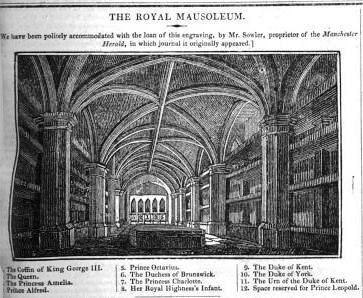
A perspective view of the Royal Vault was drawn in the late nineteenth century and includes the following key:

  • HRH Prince Octavius 1783
  • Princess Amelia 1810
  • King George III 1820
  • Queen Charlotte 1818
  • HRH Prince Alfred
  • Infant daughter of the Duke of Clarence 1821
  • Duke of York
  • Infant daughter of the Duke of Cumberland 1817
  • Duchess of Brunswick 1813
  • Princess Augusta
  • King George IV 1830
  • King William IV 1837
  • Queen Adelaide
  • Princess Charlotte
  • Infant of D’
  • Heard of D’
  • Duke of Kent
  • Heart of D’
Posted in Kings & Queens of England | Tagged , , , , | Leave a comment

St George’s Chapel Windsor – The Tomb of Charles I – 1625-1649

As well as a full and graphic description of the King’s execution there is a detailed account of his burial, including such reports as ‘after the execution the King’s body was taken to the back of the Banqueting Hall and there embalmed and placed in a coffin covered with a black velvet pall’. Then on the 7th February the body was taken to Windsor for burial and, after much dispute as to a choice of burial location within St George’s Chapel, it was placed in the Henry viii vault in the empty space once intended for Katherine Parr.

Royal tombs had for centuries been opened for inspection either for medical, historic, opportunist, research or even curiosity motives and so the opening of King Charles’ tomb in 1813 might not altogether be so strange. However!

Not for the first time, there was uncertainty as to where the King was actually buried (there were few monuments to departed Monarchs since Elizabethan times and burial records seemed regularly controversial or ambiguous), so when, in the course of construction of the vault for George iii, the vault of Henry viii was accidentally breached, the Prince Regent understandably had it inspected. Among those present was Sir Henry Halford, personal physician to the Prince, President of the Royal College of Surgeons, and who had lineal connection with the baronetcy of Wistow Hall whose first Baronet was a friend of Charles i.

The rest of the events surrounding this occasion may have been normal at the time but, I venture to suggest, are strange to modern concepts of propriety.

It is well documented that, in his medical capacity, Sir Henry Halford was allowed to remove the neck-bone, the pointed beard and a tooth. It is also implied that he took some of the hair from the back of the head, which his own report says, ‘has been cleaned and dried’. These relics remained in the possession of the family at Wistow Hall in Leicestershire for seventy-five years until 1888. As time advanced, Sir Henry St John Halford, grandson of the surgeon, felt some concern over their possession and, as he had no heirs except his brother John, then Rector of Brixworth, he decided to return them to the Prince of Wales who, not surprisingly, was said to have given Sir Henry’s grandson ‘a cool reception’.

Posted in House of Stuart | Tagged , | Leave a comment

Northampton’s Connections

Northampton’s prominence as the once home for the Royal Court, Royal Mint and for a short time a University, has been overtaken by time, but the importance of the town and county is reflected in some of the notable events that have taken place there. Although this is a study of Kings’ and Queens’ burials, I feel compelled to list some of the significant events to which Northampton and this County have been a witness:

  1. King Canute (1016-1035) takes as a ‘temporary’ wife, Aelfgigu, the daughter of the Earl of Northampton. He subsequently married Emma who bore him a son – Hardicanute (King – 1040-1042).
  2. Northampton railway station is on the site of the 12th century castle of which nothing remains (the ‘postern gate’ is a later reconstruction). But it was at the castle in 1164 that Thomas Becket had the worst of his rows with King Henry ii fleeing to London (via Becket’s Park and Becket’s Well) and into exile. Soon after his return from France in 1170, he was murdered at Canterbury Cathedral on 29th December.
  3. King Richard i grants Northampton its Charter in 1189 in return for funds for the Crusade.
  4. In 1211 King John’s long quarrel with Rome resulted in Pope Innocent iii sending ‘Pandulf’, his Papal Legate to excommunicate the King and read ‘The Instrument of Interdict’ prohibiting all Christian Rites and Services throughout the land. It was delivered and read to the King and his Court while they were at Northampton Castle. It was also at Northampton Castle that the Barons pressured King John to agree the Magna Carta.
  5. King Edward i decides to go on Crusade and ‘Takes up the Cross’ from the Papal Legate ‘Ottobuono Fieschi’ at Northampton Castle in June 1268.
  6. On the death of Queen Eleanor at Harbury, Lincolnshire, in 1290, King Edward i had her body taken to London for burial, erecting twelve ‘Eleanor Crosses’ at each place her body rested on the journey. Only three now remain of which one is in the County at Geddington and another in Northampton.
  7. Battle of Northampton. One of many during the ‘Wars of the Roses’, was fought ‘outside the walls’ on July 10th 1460 when King Edward iv captured King Henry vi. It took place between ‘Delepre’ Abbey (St Mary-de-le-Pre meaning St Mary in the meadow), and the River Nene at Nunn Mills Road. As part of Henry viii’s Dissolution, the Abbey was closed in 1538.
  8. In April 1464 Edward iv secretly marries Elizabeth Woodville at Grafton Regis (between Roade and Stony Stratford) thus igniting the fuse for Richard iii’s usurpation in 1483. King Henry viii added the suffix ‘Regis’ meaning ‘of the King’ in 1541.
  9. Richard iii was born at Fotheringhay Castle on 2nd October 1452. Mary Queen of Scots was beheaded at Fotheringhay Castle on 8th February 1587.
  10. ‘Princes in the Tower’. On the death of Edward iv, the new King Edward v and his brother, Richard of York, accepted the invitation of their Uncle Richard to travel down to London from Ludlow Castle. They stayed over in Northampton before resuming their journey to St Albans on 3rd May 1483. Edward of course was never crowned or heard of again.
  11. Peterborough. Never part of Northamptonshire (variously being ‘The Soke of Peterborough’ and now in Cambridgeshire) but difficult to exclude owing to its intrinsic connection as the County’s Diocesan Cathedral City. That allows me to include the tomb of Queen Katharine of Aragon who died in 1536 – first wife of King Henry viii.
  12. Naseby in 1645 was the site of the most decisive battle in the Civil War, the day being given to Oliver Cromwell’s troops after which King Charles i lost his throne and eventually his head. During his subsequent capture, and imprisonment, he was for a while in 1647 held at Holdenby House near East Haddon before being moved to Carisbrooke Castle on the Isle of Wight.
  13. Of more recent interest, and probably the only Royal to be buried in Northampton(shire), is Diana – Princess of Wales, who was laid to rest on the island in the middle of the lake at her family’s home – Althorp in 1997.

Postern Gate     Postern Gate Plaque

Above: Northampton Castle’s Postern Gate.   Below: ‘Becket’s Well’ and Northampton’s ‘Eleanor Cross’.

Beckets Well     Eleanor Cross

The mound of rubble, which is all that remains of Fotheringhay Castle. A remnant of the castle’s masonry.

Fotheringhay     Fotheringhay Plaques

The plaques from left to right commemorate – the birth in the castle of King Richard iii in 1452; masonry from the castle keep protected by the Peterborough Archaeological Society; The beheading of Mary Stuart, Queen of Scots, in the Great Hall on 8th February 1587.

Posted in Kings & Queens of England | Tagged , , , | Leave a comment

Northampton’s Connections cont.

‘Delepre’ Abbey. The cortege of Queen Eleanor, wife of King Edward i, Delapre Abbeystayed overnight on its journey to London in 1290. In 1460, the Abbey was the location of the Battle of Northampton.


Below: the west front of Peterborough Cathedral and the tomb of Katharine of Aragon – first wife of King Henry viii.

Peterborough Cathedral     Queen Katharine    Queen Katharine 2

Holdenby House – temporary ‘home’ of Charles i.    Holdenby      Naseby

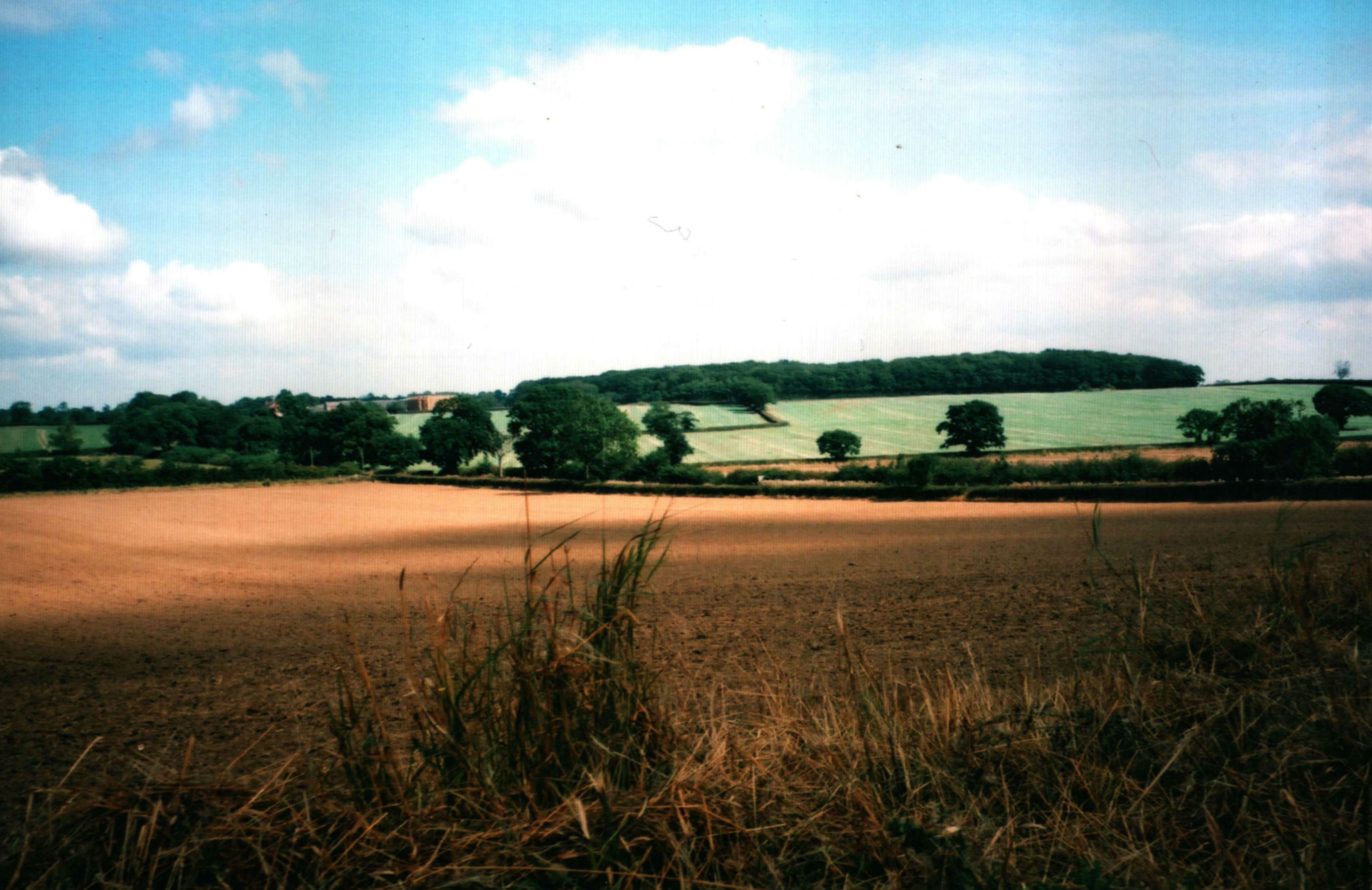
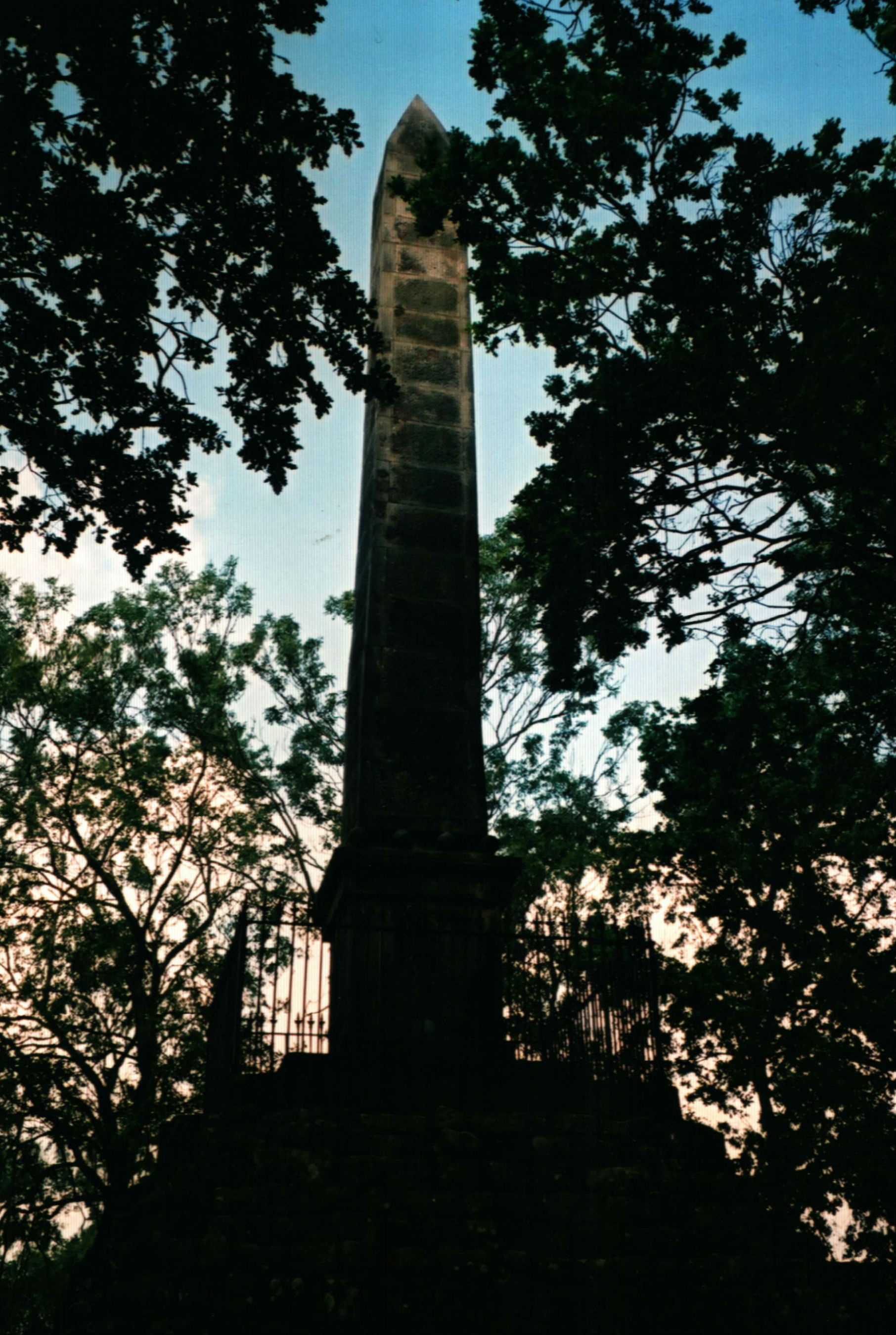
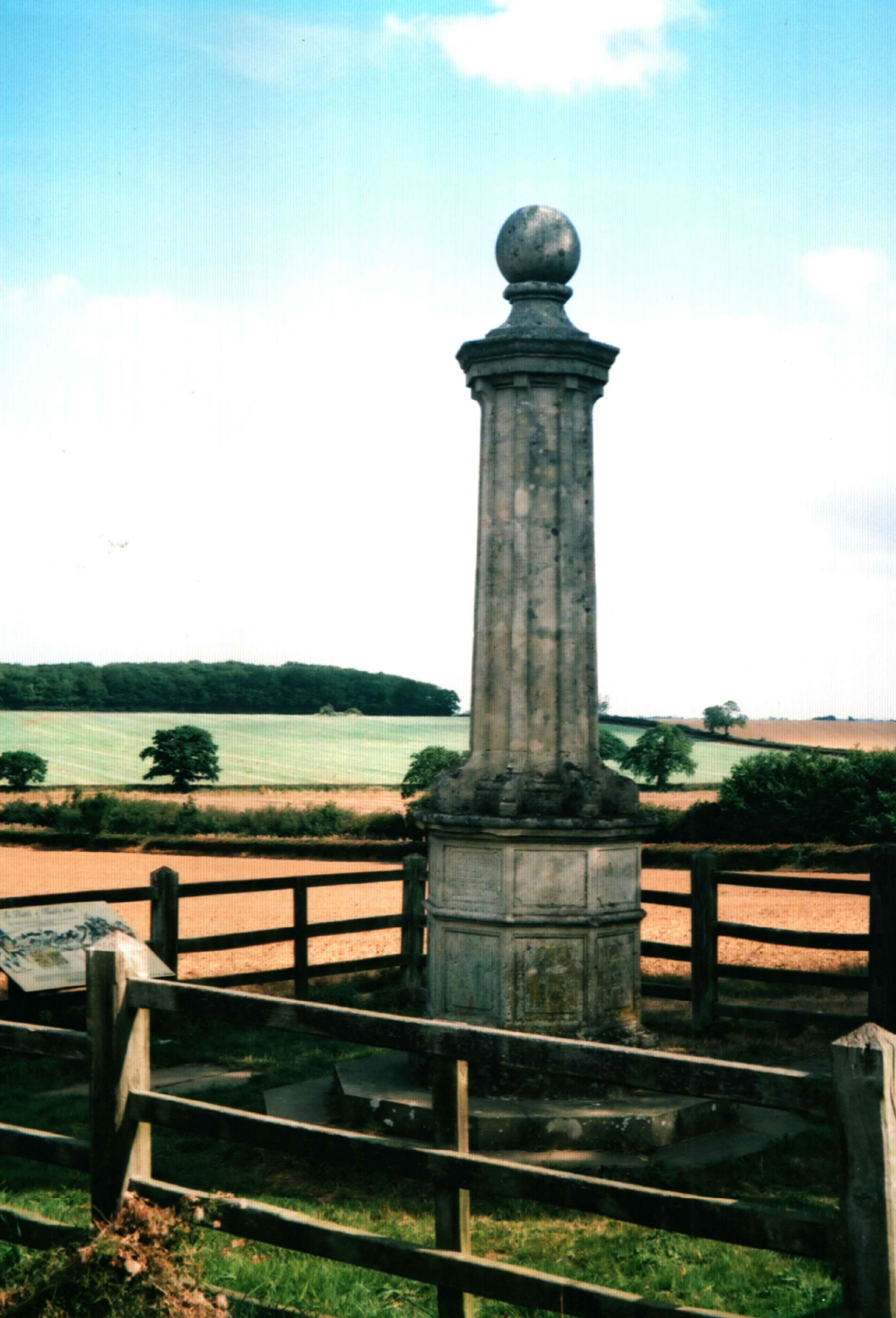
The battlefield of Naseby, above right.  Below: the obelisk commemorates the battlesite at Naseby in 1645.  The monument marks the place from which Oliver Cromwell and his troops made the final and decisive charge in the Battle of Naseby.

Naseby Obilisk      Naseby Monument

Diana – Princess of Wales, was laid to rest on the island in the middle of the lake at her family’s home – Althorp – in 1997.

Diana Memorial     Island

Posted in Kings & Queens of England | Tagged , , , , | 1 Comment

St. George

It might come as no surprise, that I have for some time been a member of The Royal Society of St George – Patron Saint of England whose date is 23rd April. It also happens to be the date of William Shakespeare’s birthday and the Coronation of Charles ii in 1660.

This Nation also enjoys a benefit not available to many parts of the world – ‘Freedom’. It has been won at the cost of millions of lives and is probably the most precious gift mankind could wish to have. Foreign Monarchies and political powers have often been the instigators of the threats to our freedom, while our own Kings and Queens have been the focus for their subjects to turn to in times of crisis.

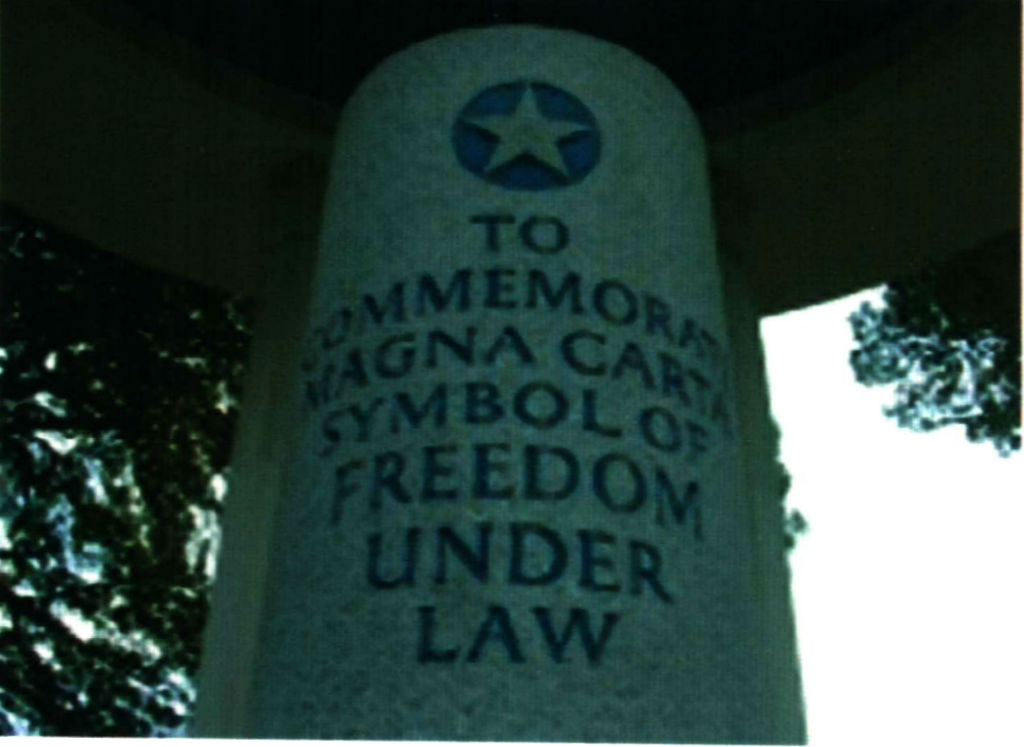
The views of the Magna Carta memorial below, which was sealed by King John in 1215 at Runnymede, will I hope, be a constant reminder of the debt we owe to those who died to keep this Nation free.

Runnymede 1        Magna Carta

MC Download Queen large

To the right: “Portrait of The Queen, taken in 2002. © John Swannell/Camera Press.”

Downloaded as permitted from http://www.royal.gov.uk


______________________________________________________________

Finally: warm thanks to Vicky Cole for her hard work and ingenuity in translating my original portfolio to this digital site. 


Posted in St George | Tagged , , | Leave a comment